








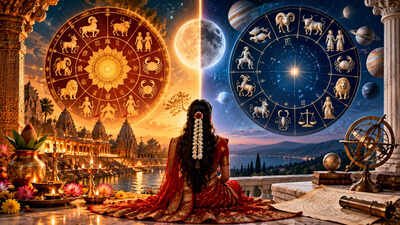
You’ve been a Libra your whole life. Then an Indian friend reads your Navratri horoscope and calls you a Virgo. Or a Kanya, which turns out to mean the same thing.Nobody made a mistake. You’re looking at two different systems of astrology, built on two different maps of the sky. During Navratri season, when Vedic horoscopes flood social media, the difference becomes hard to miss.
Two Zodiacs, One Sky
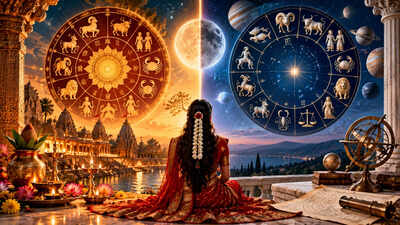
Western astrology uses the tropical zodiac. It’s anchored to the seasons. The zodiac always begins at the spring equinox, the moment around March 20 when the Sun crosses the celestial equator. That point is called 0° Aries every single year.Vedic astrology, also called Jyotish, uses the sidereal zodiac. It’s anchored to the actual stars. Signs line up with the constellations behind them.About two thousand years ago, these two zodiacs matched almost perfectly. Since then, they’ve slowly drifted apart.
Blame the Wobble
Earth wobbles on its axis, a bit like a spinning top slowing down. This wobble is called precession. It shifts the equinox point backwards against the stars by about one degree every 72 years.Add that up over centuries, and the gap between the two zodiacs today is roughly 24 degrees. This gap is called the ayanamsa.Since each sign spans 30 degrees, a 24-degree shift moves most people back one sign. If you were born in roughly the first three weeks of your Western sign, your Vedic Sun sign is probably the one before it.
Navratri 2026 Shows the Gap Clearly
This October is full of examples.·New Moon, October 10: Western astrology places it in Libra. Vedic charts put it in Virgo.·Venus retrograde, from October 3: Western astrologers have it starting in Scorpio. In Vedic terms, it’s retrograde in Libra, its own sign.·Jupiter: It’s in Leo in Western charts. Vedic charts show it in Cancer, where it’s exalted, which is why Indian astrologers are so excited about this Navratri.·The Sun: It entered Western Libra around September 22. In Vedic astrology, it doesn’t enter Libra until October 17, a day celebrated in India as Tula Sankranti.Same planets. Same moment. Different labels.
Sun Sign or Moon Sign?
There’s a second reason Vedic horoscopes feel unfamiliar. They usually don’t lead with your Sun sign at all.In the West, “What’s your sign?” means where the Sun was when you were born. In India, the more common question is your Rashi, which is your Moon sign. The Moon moves quickly, changing signs every two and a half days, so it’s seen as a better reflection of your mind and emotions.So when you read a Navratri Rashifal, it’s almost always written for your Moon sign. You’ll need your birth date, time and place to find it. Plenty of free online calculators can do this in under a minute. Make sure you pick the Lahiri ayanamsa setting, which is the standard in India.
Which One Is Right?
Neither system is “wrong.” They simply ask different questions.Western astrology follows the seasons. It’s rooted in the rhythm of light and dark across the year, which is why Aries season always begins with spring.Vedic astrology follows the stars themselves. It also comes with its own tools, like nakshatras, the 27 lunar mansions, and dashas, long planetary periods that map out phases of a person’s life.Many people find both useful. A Western chart can feel great for personality and psychology. A Vedic chart is often used for timing, such as when to start a business or fix a wedding date.
Try Both This Navratri
Look up your Vedic Moon sign before October 11. Then read a Navratri Rashifal written for it, alongside your usual Western horoscope.You might find they say surprisingly similar things. Or you might find that one simply clicks more. Either way, you’ll have a much better idea of why that Indian friend kept calling you a Kanya.