









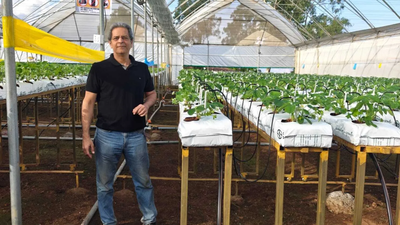
In 2016, Ketan Sodha bought 5,000 strawberry plants from a local farmer and decided to try cultivation in Mahabaleshwar. He had no farming background, and his first attempt ended in failure. But instead of abandoning the idea, the Mumbai businessman increased his plantation to 10,000 plants the following year and continued learning how to grow the fruit.A decade later, the 57-year-old’s venture, Berry Fresh Agrotech LLP, has a soilless strawberry farm in Mahabaleshwar with a capacity of 19,500 plants. The farm has reportedly produced around 8,000 kg of strawberries and generated approximately ₹44 lakh in sales.As reported by The Better India, Sodha’s journey into farming began after demonetisation affected his agricultural land business. He had spent years connecting landowners with buyers across Maharashtra, but the slowdown forced him to consider a different line of work.
His first crop failed, but the second attempt changed things
A fourth-generation Mumbaikar from a business family, Sodha had completed his BCom from KC College under Mumbai University. He first became interested in strawberries around 2012-13, when his work took him frequently through the Mahabaleshwar region.Sodha’s first year of farming did not go as planned. “The first year actually was a disaster,” he recalled. In 2017, he increased the number of plants to 10,000. The results improved, and he began producing more fruit than several conventional growers in the area who had been farming strawberries for decades.Other farmers began approaching him for partnerships. By 2019, he was cultivating strawberries across nine acres through a partnership. By the 2020-21 season, his operations had expanded to nearly 40 acres across three locations. He was also working with imported planting material and developing his own nurseries.However, increasing production did not solve one of his biggest problems: unpredictable weather.
Unseasonal rain repeatedly affected his strawberry crops
Strawberry cultivation in Mahabaleshwar traditionally depends on the region’s cool weather. Farmers generally grow the fruit in open fields, which leaves the plants exposed to rainfall and temperature changes.Sodha told The Better India that unexpected rain around November and early December could set the crop back by 15 to 20 days, just when the plants were approaching their peak production period. “You need to recover the crop, take care of it, spray some fungicides, because the unexpected rain creates a lot of nuisance,” he said.The growing season also had a natural limitation. Conventional cultivation largely stopped during summer and the monsoon because of the heat and rainfall.Sodha began looking for a way to control the growing conditions rather than depend entirely on the weather. In 2021-22, he travelled to Italy, Spain, Egypt and Turkey, where he met nursery owners and hydroponic growers. He also consulted experts from countries including Israel, the UK, New Zealand, Australia and the US. However, he realised that farming methods developed elsewhere could not simply be transferred to India.
Why he shifted to soilless strawberry cultivation
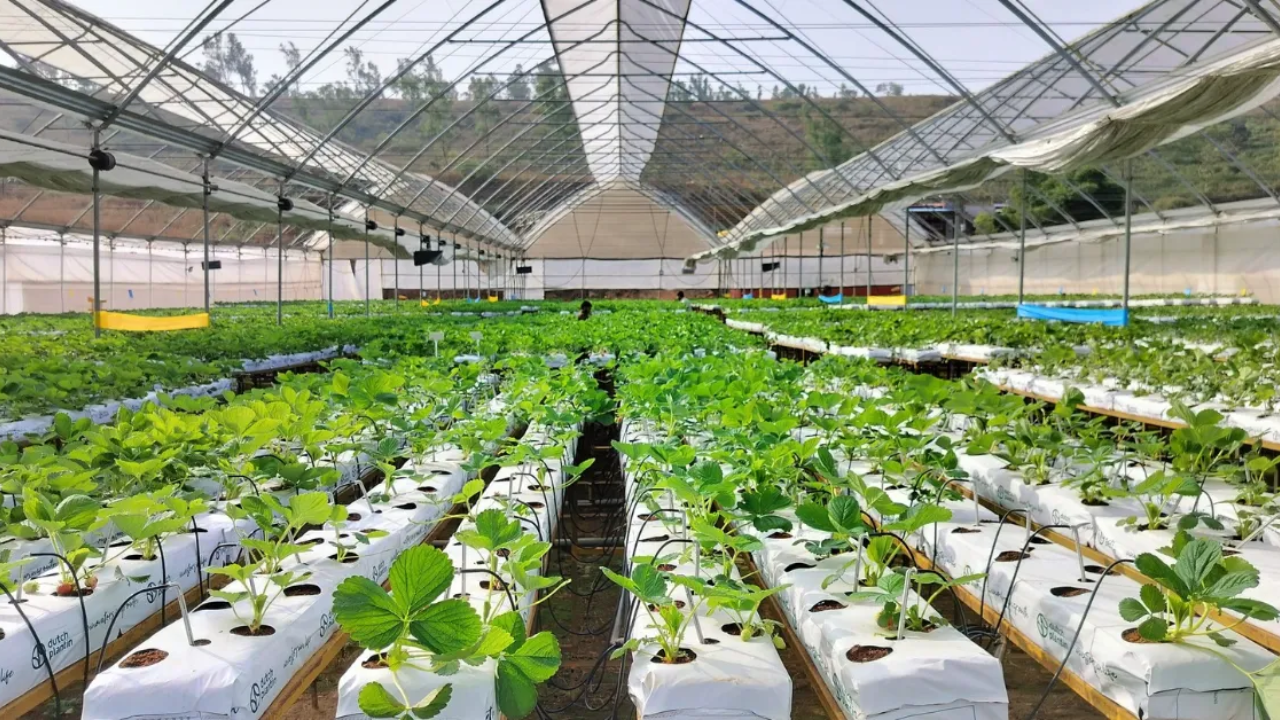
Photo credit: The Better India
Berry Fresh Agrotech LLP was incorporated on October 14, 2022. The company’s soilless plantation began in November 2024. According to The Better India, Sodha leased two acres of land in Mahabaleshwar and built a 1,500-square-metre polyhouse with the capacity to accommodate 19,500 strawberry plants.Instead of growing directly in soil, the plants are cultivated in cocopeat, a growing medium made from coconut husk. This helps reduce the risk of soil-borne diseases associated with repeatedly growing crops in the same field.The facility uses a retractable roof, a misting system and automated fertigation. Fertigation is a process in which water and nutrients are supplied together to plants in measured quantities.The farm also collects rainwater in storage facilities and treats the water with ozone before using it. Sodha explained the importance of controlling water supply and nutrients to prevent plants from receiving either too much or too little. He described the approach as a combination of several changes rather than a single farming technique.
Testing 19 strawberry varieties from different countries
Berry Fresh is also experimenting with international strawberry varieties to identify which ones perform best in Indian conditions. According to The Better India, the farm is conducting trials involving 19 varieties from places including Florida, Spain, Italy, Uruguay and Japan. It has also added a variety from the Netherlands.According to a HortiDaily report in April 2026, the farm is testing varieties from the University of Florida, Spanish and Italian breeders, Uruguay’s INIA programme and a Japanese programme called Seeds to Plant. The aim is to study differences in yield, taste, disease resistance and fruit quality. A variety that performs well in one country may not necessarily produce the same results in Mahabaleshwar.Sodha wants to identify suitable varieties for Indian conditions and eventually make better planting material available to other growers.
8,000 kg of strawberries and ₹44 lakh in reported sales
The current polyhouse has a capacity of 19,500 plants and operates at around 90 per cent of that capacity. According to the production figures shared by Sodha with The Better India, the farm recorded an average harvest of 408 grams per plant for the period from January 2024 to December 2025. Its reported production was approximately 3.2 kg per square metre.The venture has harvested around 8,000 kg of strawberries and generated approximately ₹44 lakh in sales through business-to-business and direct-to-consumer channels. The berries are sold at around ₹400 to ₹600 per kg, depending on the customer and order. Customers are spread across Mumbai, Mahabaleshwar, Delhi, Bhopal, Ahmedabad, Indore, Udupi and Goa.
His next plan is a five-acre farm with 2 lakh plants
Sodha is now discussing investments for a much larger facility. He is exploring a proposed five-acre farm in Mahabaleshwar with a capacity of at least 200,000 plants. He hopes to use the experience gained from the first polyhouse to expand the model and eventually replicate it in other parts of India where climatic conditions are suitable.His focus is also on extending production beyond the conventional strawberry season. Early harvests before the regular season and fruit availability after other growers have stopped cultivating can offer access to different market windows.The change has also meant a different daily routine for the Mumbai businessman, who now spends much of his time in Mahabaleshwar.