











Picture this: It is 2016. Summer vacations are here, and you are glued to the television, watching Doraemon. I know, this sentence alone might have sent many of you down the aisle of nostalgia. How fervently we wished that Doraemon could come to our rescue, solving mathematical problems, simplifying complex concepts, writing essays, and providing answers to almost every question we could think of. Ta-da! Wish granted.Cut to 2026, a decade later, and children actually have access to a technology that comes remarkably close to that futuristic dream. This is no longer a manifestation of a sci-fi novel; it is reality. For students today, generative AI seems to have placed everything on a silver platter. A difficult topic can be simplified, an assignment structured, and information accessed without having to spend hours pouring over books.But as artificial intelligence becomes an increasingly inseparable part of academic life, educators are confronting a more fundamental question: Is the technology helping students become better learners, or making them increasingly dependent on ready-made answers? The debate, undoubtedly, is not an easy one.
What does the survey say?
The scale of adoption is evident in the Student Generative AI Survey 2026, published by the Higher Education Policy Institute (HEPI). The survey, conducted among 1,054 full-time undergraduate students in the UK in December 2025, found that 95% had used AI in at least one way, while 94% used generative AI to help with assessed work.
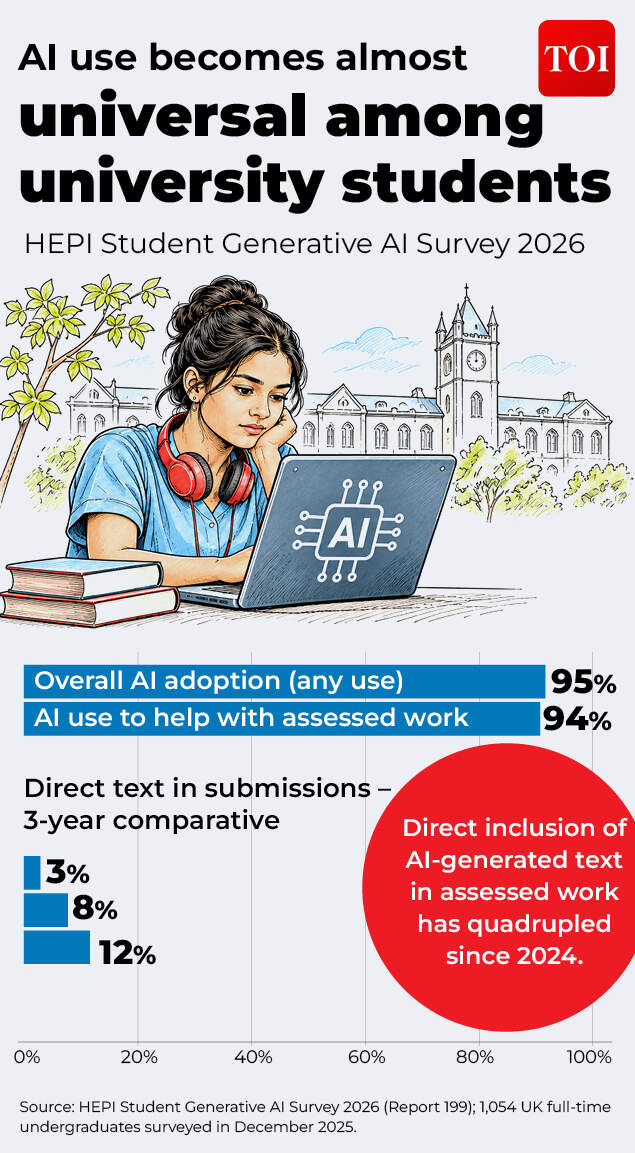
The proportion directly including AI-generated text in assessed submissions rose to 12% in 2026, compared with 8% in 2025 and 3% in 2024. The findings also show that 65% of students believe assessment has changed significantly in response to AI.Yet the survey presents a mixed picture. While 49% said AI had improved their student experience through time savings, better understanding and immediate assistance, concerns around fairness, skill erosion and social isolation also emerged. Further, 68% considered AI skills essential to thrive today, but only 48% said teaching staff helped them develop the skills needed for future careers.
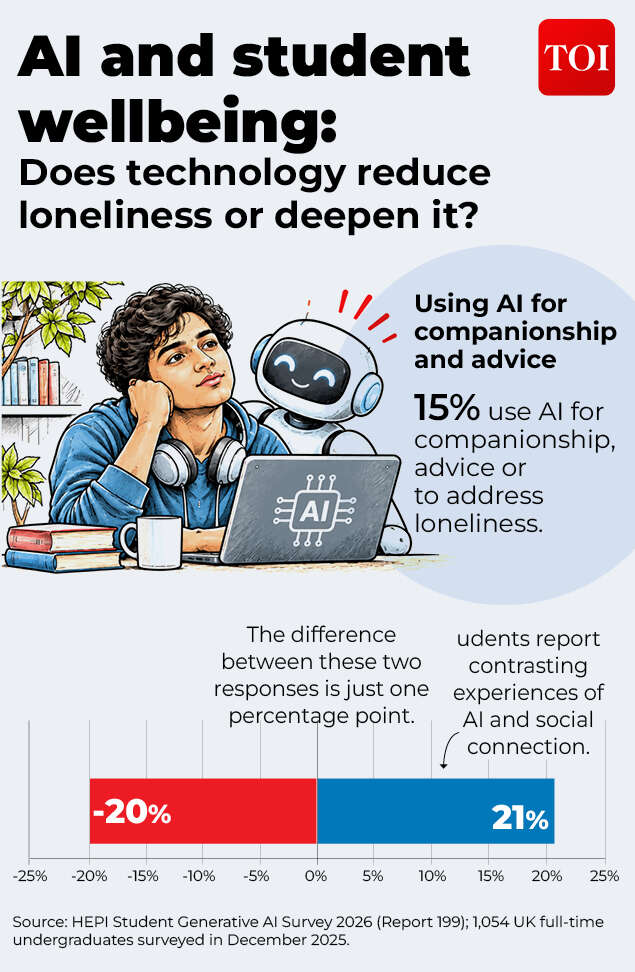
The findings reflect the experiences of UK undergraduates and cannot be treated as a measure of AI use among Indian students. However, they point to a shift that education systems can no longer ignore. The question is no longer whether students will use AI, but whether they will learn to use it without surrendering independent thought.
The debate goes on: Is AI a tool for learning or a shortcut to answers?
Preeti Khatri, CBSE assistant professor and assistant director, believes AI should be viewed as an enabling tool rather than a threat to education. She argues that the technology itself is not inherently harmful; its impact depends on how students use it.“Students may be using AI negatively, but that does not make the technology negative. It is like a knife. You can use it to cut vegetables, or you can misuse it. The responsibility lies in how it is used,” she said.Khatri points out that the National Education Policy (NEP) 2020 recognises the growing relevance of artificial intelligence and computational thinking. In her view, Indian students must be prepared to understand and work with emerging technologies instead of being left behind as their use expands globally.CBSE has introduced a curriculum on Computational Thinking and Artificial Intelligence, supported by a separate textbook and teacher-training resources for the preparatory and middle stages. Khatri says efforts are also under way to build teachers’ capacity to introduce these concepts in classrooms.However, bringing AI into the curriculum is only one part of the challenge. Students must also learn to assess the information they receive, identify limitations in AI-generated responses, and understand when the technology is appropriate to use.
CBSE’s approach puts critical thinking and assessment in focus
Khatri believes teachers will continue to play an important role, particularly in helping students develop values, ethics, and responsible judgement. While AI can provide explanations and information, it cannot replace the guidance students receive through classroom interactions.She also believes assessment methods need to evolve. Instead of testing students only on their ability to recall information or reproduce formulas, schools should place greater emphasis on application-based learning. Open-book assessments, for instance, can require students to apply a concept to a problem rather than simply retrieve an answer.Khatri does not believe that the use of AI necessarily signals the disappearance of critical thinking. Instead, she argues that the nature of the exercise has changed. Students still need to frame questions, refine prompts and evaluate the responses generated by the technology.“Critical thinking is still there. The level has changed,” she said.However, this distinction depends on students making an effort to examine what AI produces. If they accept an answer without questioning it, the opportunity to develop judgement can be lost. This is also where educators are beginning to notice a change in classroom behaviour.
Students turning to AI before attempting to understand a subject
Dr Arpita Srivastava, associate professor at XLRI – Xavier School of Management, Jamshedpur, says she has observed a shift in how students approach academic work over the past two years. Instead of first attempting to understand a question or referring to course material, some students now turn to AI almost immediately.“Their first thought is to go to AI, which is a little scary,” she said.Srivastava explains that AI-generated responses can be lengthy and appear convincing, but students may not always have the subject knowledge needed to identify errors, gaps, or misleading explanations. The problem becomes more pronounced when they accept the output without checking it against the original material.She recalls how students earlier worked through detailed case studies, sometimes spanning several pages, before discussing them in groups. Now, some upload the material to AI, obtain a summary, and rely on it instead of reading the original case.Without engaging with the source material, students may struggle to determine whether the summary captures the central argument or leaves out important details.“That is where I think it is crippling because they trust AI more than their own brains,” Srivastava said.She estimates, based on her classroom observations, that a large proportion of students do not independently verify AI-generated responses. She clarifies that these are personal observations and not findings from a formal study.For Srivastava, the distinction lies in whether students use AI to begin learning or to avoid learning altogether. Asking the tool to explain a difficult concept and then checking the explanation against textbooks, research papers or other reliable sources can support understanding. Accepting its response without scrutiny, however, can turn convenience into dependence.
AI is also expanding creative learning opportunities
Despite these concerns, Srivastava does not see AI as inherently harmful to education. She believes it can make classroom learning more practical and creative when students are encouraged to question and evaluate its output.This year, she introduced sessions in which students use AI to create advertisements and then assess the results collectively. The exercise allows them to identify generic ideas, examine the quality of the output and understand what makes an advertisement effective.AI has also widened the scope of student projects. Tasks that once required considerable time and resources, such as producing video advertisements, social media reels or promotional content, can now be attempted more easily.Srivastava says students can use these tools to develop multiple creative outputs and then examine their strengths and weaknesses. The emphasis, however, remains on whether they understand the underlying concepts of advertising and communication.She believes teachers must adapt as well.“AI can help educators develop videos, case studies and other teaching material, making lessons more engaging. But the responsibility for building judgement and subject understanding cannot be handed over to a machine. Treat AI as an assistant rather than as a master,” she said.
The challenge is to ensure students retain the ability to think independently
The debate over AI in education cannot be reduced to a choice between accepting and rejecting technology. Students will continue to encounter AI in classrooms, workplaces and everyday life. Preparing them to use it responsibly is therefore as important as teaching them traditional academic skills.For Khatri, this requires teachers to create learning environments in which students apply concepts, question information, and develop ethical judgement. For Srivastava, it means ensuring that AI does not replace the effort involved in reading, analysing and forming an independent opinion.The convenience of having an answer to almost every question may make learning faster, but access to information is not the same as understanding it. The real test for education systems will be whether students can use AI to explore ideas while retaining the ability to question its responses, recognise its limitations and arrive at conclusions of their own.AI can provide assistance. The thinking, however, must remain with the student.