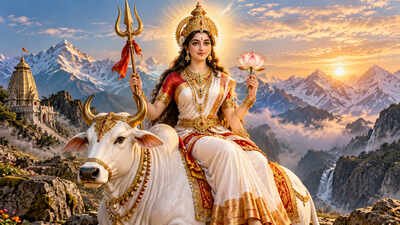








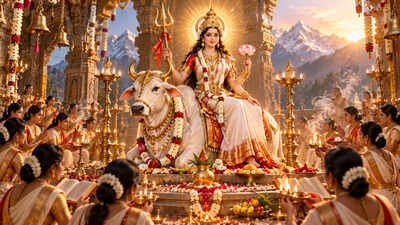
Which Shailputri do you picture: the one dressed in white or the one the 2026 calendar assigns orange? Both have their place, and they answer different questions.Start with the iconography. She has two hands, holding a trident in her right hand and a white lotus in her left, and rides a bull. This image becomes the focus of the mind during worship, especially when your thoughts feel scattered.She is worshipped on Sunday, 11 October 2026, on Pratipada, the first lunar day of Ashvin Shukla, when Ghatasthapana is performed. The muhurat falls in the early morning, approximately between 6:19 AM and 10:12 AM in Delhi, with the Abhijit muhurat, from 11:44 AM to 12:31 PM, as an alternative. Check your local panchang for timings specific to your city.
Why she suits the first morning
Her worship is astrologically associated with the Moon, which is why devotees turn to her when seeking stability. When life feels chaotic, when you struggle to make a clear decision, or when your routine keeps slipping, she is remembered as the steadfastness of a mountain. She is worshipped first so that the remaining days may unfold with steadiness.In her, the calm strength of the mountain meets the gentle light of the Moon. Looking at her, you understand what you are asking for: focus, balance, and a settled inner rhythm. The day’s prayer expresses it in one line: “Mother, please guide my life in the right direction and give me the strength to remain steadfast on that path.”
Mantras to Chant
Chanting mantras is an important part of Shailputri worship. During the puja, you can recite the following with devotion:
- Beej mantra (seed mantra): ॐ ह्रीं शिवाय नमः (Om Hreem Shivaya Namah).
- Devi mantra: या देवी सर्वभूतेषु शैलरूपेण संस्थिता। नमस्तस्यै नमस्तस्यै नमस्तस्यै नमो नमः॥
- Shailputri mantra: ॐ देवी शैलपुत्र्यै नमः।
To honour her form, you can also recite this descriptive shloka:वन्दे वाञ्छितलाभाय चन्द्रार्धकृतशेखराम्।वृषारूढां शूलधरां शैलपुत्रीं यशस्विनीम्॥Its meaning is straightforward: “I bow to Goddess Shailputri, who grants desired blessings, wears the crescent moon on her head, rides a bull, holds a trident, and is glorious and full of divine grace.”
Orange on the calendar, white in the icon
Two colour traditions meet on this date, and they come from different sources. Shailputri’s traditional iconography is associated with white. White clothing, flowers, fruits, and coconut are considered especially auspicious offerings. The colour is not merely decorative; it reflects the traditional depiction of the goddess. If you are worshipping Shailputri specifically on the first day, white is a fitting choice.The day-by-day Navratri colour list, however, is a separate, contemporary custom that assigns orange to Day 1 in 2026. Many households follow this list as a shared marker throughout the festival. If you are observing the full Navratri, wearing orange aligns with that tradition, while red clothing and red flowers remain longstanding choices in the worship of Goddess Durga.Neither choice needs to conflict with the other. Follow the tradition observed by your family, and you can still offer white flowers and other traditional white offerings to the goddess.One particularly important offering in Shailputri worship is pure cow’s ghee. If you remember only one offering, let it be this. Keep your worship simple, sincere, and devoted.
A remedy for the restless mind
Who might find meaning in Shailputri’s worship? Those who struggle to begin new projects, repeatedly second-guess their decisions, or experience uncertainty in their careers may find inspiration in her symbolism of stability. Parents may also pray for children who struggle to concentrate while studying.The traditional devotional practice is simple:
- Place pure cow’s ghee before Goddess Shailputri as an offering.
- Recite her mantra, Om Hreem Shivaya Namah, as many times as you can with devotion.
- When the prayer is complete, receive the ghee as prasad, the blessed offering.
Some devotional traditions also associate this offering with improved concentration and mental steadiness. However, these are matters of religious belief, not scientifically established effects. Prasad should be consumed in an appropriate quantity, and children should not be given ghee as a treatment for concentration difficulties.Keep the ghee pure, keep the chant unhurried, and let the offering be the final act of worship.