








If you have travelled by train in India, you may have noticed that railway coaches do not all look alike. Some are the familiar blue, while many newer trains have red coaches. Others feature different colours and liveries.It is easy to assume that each colour has a fixed meaning. In reality, coach colour is mainly part of a particular coach’s paint scheme and can sometimes help identify its design or service, but it is not a universal code for passenger class.Here is what the colours can tell you.
Blue coaches: The traditional ICF design
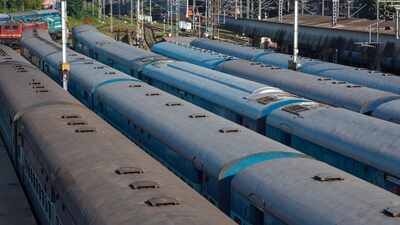
The blue coaches commonly seen on Indian Railways are largely associated with ICF-type coaches.ICF stands for Integral Coach Factory, the Chennai-based production unit that developed and manufactured a large number of conventional passenger coaches.Indian Railways’ coach painting specifications include blue shades for conventional coaches, which helped make the blue coach a familiar sight across the network.However, blue does not automatically mean Sleeper Class, General Class, or any other single category. Different types of conventional coaches can share similar exterior colours.
Red coaches: Commonly associated with LHB coaches
The red coaches seen on many modern trains are generally associated with LHB coaches.LHB stands for Linke Hofmann Busch, the German design adopted by Indian Railways. Production of LHB coaches began at the Rail Coach Factory, Kapurthala, following a technology-transfer agreement with the German company.LHB coaches differ from the older ICF design in their construction and underframe arrangements and have become increasingly common across Indian Railways.The red exterior is therefore a useful visual clue, but it should not be treated as a rule that every red coach belongs to one particular passenger class.
Does a red coach mean AC?
No.A coach’s colour does not by itself tell you whether it is AC 2 Tier, AC 3 Tier, Sleeper Class, or another category.LHB coaches are manufactured in several configurations, including both air-conditioned and non-air-conditioned variants.If you are looking for your coach at a crowded station, the coach number and class marking are much more reliable than its colour.
What do green coaches mean?
Green coaches have appeared in different railway colour schemes, which is why there is no single meaning that can safely be assigned to every green coach.The colour can be part of the livery used for a particular coach, rake, or service. Railway specifications also contain different exterior colour schemes for different types of coaches.This means claims such as “all green coaches belong to one particular train category” can be misleading.
Why are there so many coach colours?
Indian Railways operates a large and evolving fleet rather than one standard type of passenger coach.Alongside conventional ICF coaches and LHB coaches, the network includes specialized and newer coach designs used for different services. Their liveries can therefore differ.The colour is only one part of the coach’s appearance. Its design, markings, equipment, and configuration provide a much clearer picture of what type of coach it is.
What should passengers actually look at?
If you need to identify your coach, don’t depend on colour alone.Check the coach number, class designation, and information displayed at the station or on your ticket. These details tell you where you need to board and what type of accommodation you have booked.Colour can help you recognize a coach from a distance, but it is not a substitute for the official markings.Thumb image: Canva (for representative purposes only)