










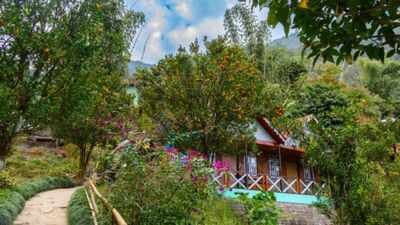
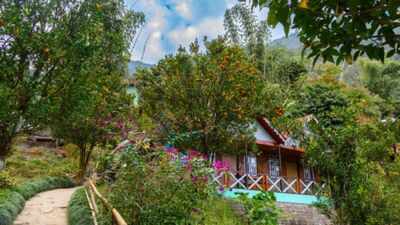
Most people look at a bare rooftop and see wasted space, maybe a spot for drying clothes, or storing things nobody wants downstairs. Haroon Rashid looked at his and saw a farm.Today, the terrace of his second-floor home in Vehil village, south Kashmir’s Shopian district, is bursting with nearly 100 varieties of herbs, vegetables and fruit, a green, living contradiction in a region famous for something else entirely: apples.
A different kind of harvest in Apple country
Shopian’s identity is built on its orchards, mile after mile of apple trees that define the district’s economy and landscape. But 55-year-old Rashid has taken a different route.Instead of an orchard, he has a terrace measuring roughly 40 feet by 42 feet, and instead of one crop, he grows dozens of vegetables, herbs, even oranges, all sharing the same modest patch of space two floors above the ground.“I cultivate both horticulture and agriculture crops,” Rashid told Greater Kashmir as if growing an entire farm’s variety on a rooftop were the most natural thing in the world.
No chemicals, just patience and manure
What sets Rashid’s garden apart isn’t just its location, it’s the philosophy behind it.He avoids chemical fertilisers, relying instead on organic manure to nurture his plants.“The input cost is less because I use organic manure and grow the crops myself,” Rashid told the outlet.This wasn’t an incidental choice. Watching the growing use of chemical fertilisers in Shopian’s apple farming left him uneasy. “Shopian is known for apples, but there has been a lot of use of chemical fertilisers. I believe this affects soil and health,” he explained.So on his own terrace, he does things his way, slower, perhaps, but rooted in a concern for the land and the people who eat from it.It also happens to be lighter on the pocket, since organic manure and his own labour keep expenses down.
A terrace that pays its own way
It might be easy to assume a rooftop garden is just a hobby, something to fill idle hours.But for Rashid, it’s also a genuine source of income. He earns between Rs 70,000 and Rs 80,000 a year from what grows on his terrace, a respectable return from a space most people would never think to farm.Low input costs make the arithmetic work in his favour: when you grow your own manure-fed crops with your own hands, there’s little overhead eating into the profit.It’s proof that productivity doesn’t always need sprawling fields, sometimes it just needs a bit of imagination and consistent care.
Diversity as a way of farming
Perhaps the most striking part of Rashid’s garden is the sheer variety.Around 100 kinds of herbs, vegetables and fruit share that small terrace, a mix of familiar local produce and more unusual crops rarely grown in the area.In many ways, this mirrors an older Kashmiri farming tradition, one built on diversity rather than dependence on a single crop, just reimagined for a space where conventional agriculture would be impossible.There’s no vast field here, no rows stretching into the distance. Just careful planning, layered planting, and a willingness to experiment.For Rashid, the terrace is more than extra income. It’s a quiet demonstration that food can be grown thoughtfully, without heavy chemical use, and that unused urban or semi-urban spaces don’t have to stay unused. As he puts it, “Even a small space can be productive if it is properly utilised.”In a district known for its orchards, his rooftop stands as a small but persuasive argument, that good farming isn’t only about how much land you have, but how well you use what you’ve got.