








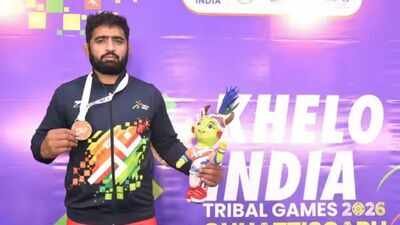
For years, Hamam Hussain’s days began with responsibilities that had little to do with sport. Alongside his elder brother, he helped deliver milk from door to door to keep the family going after their father passed away. Yet, somewhere between those daily rounds and the demands of home, he continued to make time for wrestling.At 28, the wrestler from Jammu finally reached a milestone he had pursued for 14 years. At the Khelo India Tribal Games 2026 in Chhattisgarh, he won the men’s 79kg freestyle gold, defeating Mohit Kumar of Himachal Pradesh. It was his first gold medal at the national level. The victory was more than a sporting result. It brought recognition to years of training in modest conditions, family sacrifices and a dream that never quite left him.
When family responsibilities came before the sport
Hamam’s life changed after his father died around five years before his breakthrough. The family had to find a way to manage its expenses, and his elder brother took charge of the household by selling milk. The buffaloes their father had left behind became an important source of livelihood. His brother had also wrestled at the state level, but family responsibilities meant he had to step away from the sport. Hamam began accompanying him on milk deliveries, helping wherever he could.“My brother had to quit wrestling and started selling milk. I would go with him to deliver milk as it was necessary for us to run the family. But he motivated me to continue wrestling and took me to dangals,” Hamam told SAI Media. The family’s circumstances could have pushed him to give up wrestling as well. Instead, his brother encouraged him to keep competing. Hamam continued to visit local wrestling events and train whenever he could. He later described how stepping into the mud akhada made him fall in love with the sport. The responsibility of earning a living remained, but wrestling continued to be part of his life.
Training meant long journeys and limited facilities
Hamam’s path to the national stage was not supported by the kind of infrastructure often available to athletes in larger cities. He trains at a mud akhada nearly 20 kilometres from his village. For practice on wrestling mats, he travels around 40 kilometres to Jammu. He does not have a personal coach at his village akhada. Instead, senior wrestlers guide him during training, while coaches are available when he gets an opportunity to practise on mats. The distance to the Sports Authority of India centre in Jammu also makes regular visits difficult. Hamam said he generally goes there when competitions are scheduled, relying on the mud akhada for much of his preparation.Balancing training with work and family duties requires careful planning. His routine is a reminder that an athlete’s preparation does not always happen inside a well-equipped sports centre. For some, it involves travelling long distances, making use of available spaces and learning from whoever can offer guidance. Hamam has also spoken about the gap in facilities between rural and urban areas. He believes better training support in villages could help more wrestlers from the region compete successfully at national and international levels.
Fourteen years of effort finally bring a gold
The breakthrough came at the Khelo India Tribal Games 2026, held in Chhattisgarh. Competing in the men’s 79kg freestyle category, Hamam defeated Mohit Kumar of Himachal Pradesh to win the gold medal. For a wrestler whose career had stretched across 14 years without a national-level gold, the result carried a personal meaning. It recognised not only his performance in the competition but also the years spent continuing despite financial and training challenges.Hamam said the facilities at the Games were good and welcomed the opportunity the event provided to athletes from areas where sporting support can be limited. He also expressed hope that more competitions of this kind would give emerging wrestlers from remote communities a chance to show what they can do. His achievement was reported by Khelo India and carried by news organisations including PTI, Rediff and Kashmir Observer. These reports confirm that the gold was his first at the national level in a 14-year wrestling career.
A medal that carries his family’s sacrifice
Hamam’s story is closely tied to the people who helped him continue. His elder brother gave up his own wrestling ambitions to take on family responsibilities but still encouraged Hamam to pursue the sport. The milk deliveries helped sustain the household while keeping the wrestler’s dream alive. The gold medal therefore represents more than one athlete’s achievement. It also reflects the support and sacrifices that made his continued participation possible.Hamam has pointed to the need for better facilities and coaching opportunities for wrestlers from villages. His own experience shows how much effort can go into reaching a competition when training centres are far away and resources are limited. At 28, he has finally won the national gold he had been chasing. The journey from delivering milk with his brother to standing on the top of the podium was not a straight road. It took 14 years of persistence, long commutes and a family that kept his dream alive. For Hamam Hussain, the medal is a milestone. It is also a reminder of the people and the everyday work that helped him reach it.